Nihongodict rises from the dead
Last weekend Nihongodict went off the air. The URL was parked by GoDaddy. And I feared the worst, because I use it a lot.
I sat down this evening to write an obituary, and tried it one last time AND IT WAS BACK AGAIN! YAY!
Probably someone forgot to pay the registration fee for the URL, and fortunately it wasn't instantly grabbed by SEO vultures or porn spammers. I guess GoDaddy gives you a grace period before auctioning it off to the vultures.
An SEO vulture tried to buy "denbeste.nu" from me one time; they contacted NuNames who forwarded the offer to me, such as it was. Anyway, I've got it paid up to 2022.
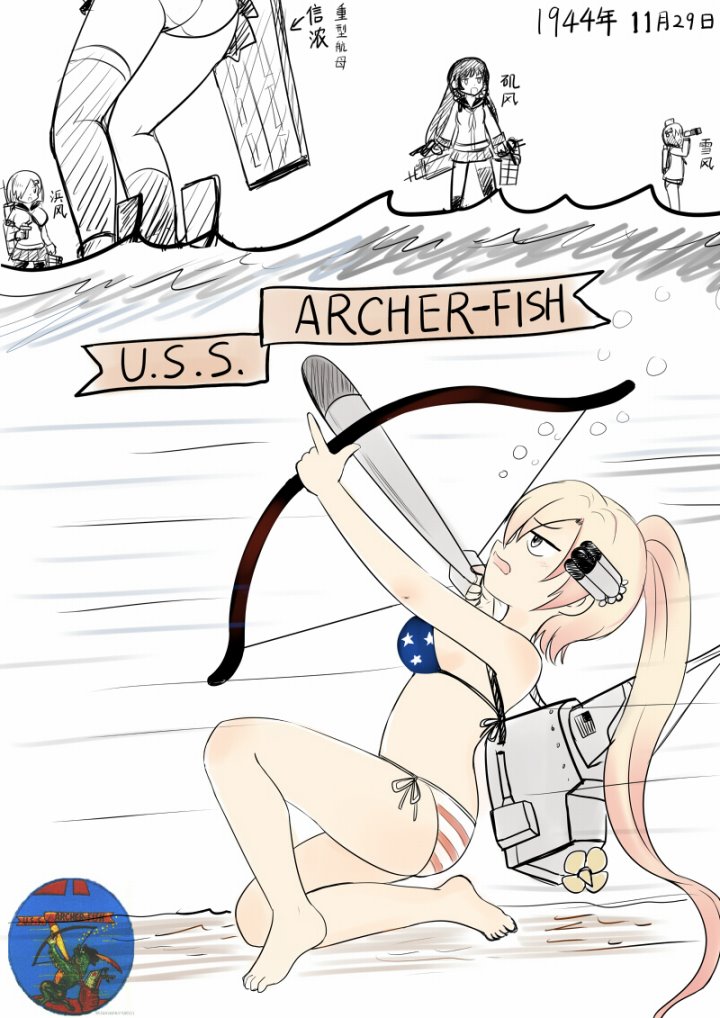
In my never-ending search for cheesecake I ran into this
post. It doesn't really count as cheesecake but I thought it was noteworthy
anyway.
USS
Archerfish was an American submarine in the Pacific during WWII, and it is
particularly noteworthy because it sank IJN
Shinano.
Shinano was the third hull of the Yamato series. Yamato and Musashi
eventually became battleships but while Shinano was still in construction the
decision was made to turn her into an aircraft carrier. She was commissioned in
November 1944 and was being moved from Yokosuka to Kure when she was spotted by
Archerfish.
Archerfish stalked Shinano for six hours and finally achieved a nearly ideal
firing position. 4 out of 6 torpedoes hit, causing flooding which Shinano's
rookie crew could not stop. She eventually capsized and sank.
So I think it's pretty remarkable that this Japanese artist honors Archerfish
in this way, since although cartoony (and clearly based on KanColle) it's
really rather respectful.
I guess you could claim that they do the same with USS Iowa, but that's not
really the same. First off, Iowa is being drawn mostly as a fan service object.
Second, Iowa is a ship you can get in Kancolle. I don't think there are any
submarines in that game. (I could be wrong. There are no submarines in World Of Warships but there might well be some in KanColle. It's easy to get the two confused.)
That same post also includes a picture of USS
Albacore, which is noteworthy for having sunk IJN
Taihou during the battle of the Philippine Sea. Sadly, Albacore didn't
survive the war and was lost with all hands (the most common fate for an
American submarine). Her fate isn't known for certain but she probably struck a
mine.
Time heals wounds and I guess a modern Japanese can look back and honor a
gallant foe (by putting her in a stars-and-stripes bikini).
Other notes: CV-2 is the first USS Lexington, which was sunk at the Battle of
Coral Sea. CV-16 is the second USS Lexington, which survived the war. The
Japanese carrier they're shown fighting is Zuihou, which participated in Coral Sea and was sunk at Leyte Gulf by American carrier air strikes, including planes from the second Lexington.
Other notes: CV-2 is the first USS Lexington, which was sunk at the Battle of Coral Sea. CV-16 is the second USS Lexington, which survived the war. The Japanese carrier they're shown fighting is Zuihou, which participated in Coral Sea and was sunk at Leyte Gulf by American carrier air strikes, including planes from the second Lexington.
I presume that the Japanese carrier is suppose to be Zuikaku? Zuiho was not at Coral Sea but her sister ship Shoho (No, I do not play with the extra 'u' some romanizations add to Japanese words.) and the two big flattops of CarDiv 5 (Shoukaku and Zuikaku.) were.
Posted by: cxt217 at July 10, 2016 02:56 PM (DuUoO)
2
While I don't play Kancolle, I've seen enough on the image boards that I can say that they have several Japanese subs and 1 German sub (who oddly enough goes from vaguely German looking to vaguely Gangoro in her second form) in the game, but no American subs yet.
Albacore's design here comes from a similar smartphone Chinese game, Zhan Jian Shao Nyu (aka Warshp Girls) which has implemented an array of ships from a much wider number of countries.
Posted by: StargazerA5 at July 10, 2016 04:32 PM (5YSpE)
3
I can believe that. I keep forgetting about that other game.
4
There are 10 submarines in Kancolle, including an army submersible transport and its upgrade, and four submarine aircraft carriers. (Never heard of those before.) You can get the "U-Country" Archerfish in the Warship Girls game. The post looks like it's from a Chinese artist (no kana).
Posted by: muon at July 10, 2016 10:02 PM (IUHrD)
5
It looks like you're right. On the artist description page, the "self description" is written in Chinese.
That rather puts a hole in my thesis below the waterline, don't it?
He stabbed her 20 times, including once in the neck. The only reason she didn't die immediately is that he was using a pocket knife. But there isn't anything else good about it. Depending on what he hit in her neck, it may be impossible for her to fully recover. With that many wounds it may be impossible anyway, and even if she can it'll take a long time.
Anyway, according to the report she hasn't regained consciousness, which is never a good sign.
(Note: there are apparently two idols with this name. This isn't the one who is in AKB48; this is the one who starred in the show "Secret Girls".)
UPDATE: Of course, there isn't anything new about rabid fans; ask John Lennon or Jodi Foster. But it's still sad when it happens.
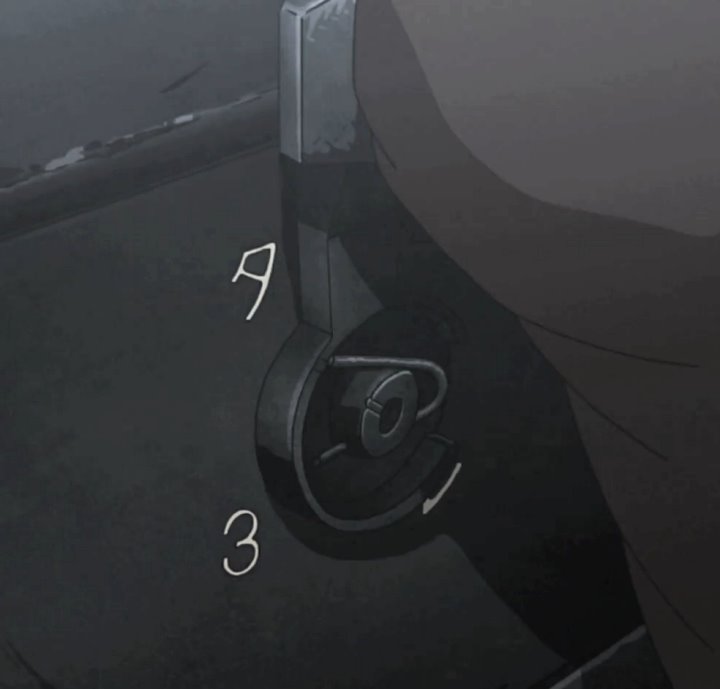
This frame comes from the second-to-last episode of GATE. Paratroopers are
about to relieve the Rose Knights defending the Jade Palace and this soldier is
about to open up on the legionaries. And we see him flip that switch to its
upright position.
That rifle has a triple-burst mode (we see Kuribayashi using the triple-burst mode in the
last episode) and clearly that's what the "3" means. It's the other
symbol, on the top, I'm curious about. What is that symbol and what does it
mean?
It's possible it's タ ta in katakana. It's also possible it's 夕
which is a kanji that seems to be pronounced yuube and means
"evening". But I'm not sure about either of them because they aren't
exactly the same as what's in that image. I'm assuming the symbol on the rifle
means "full auto" but I can't figure out how to get there from that
symbol.
Posted by: Mikeski at May 16, 2016 02:37 PM (rKjqN)
2
...and, thus, semiautomatic mode, not full-auto. The mostly-obscured katakana "re" at about 5:00 is for "rensha" == "full auto". The safety must be a separate switch somewhere, since I don't see a 4th position.
(Or they forgot to draw a 4th character around 2:00.)
(...the preview button and the post button are also different things, Mikeski. Sorry for the clutter.)
Posted by: Mikeski at May 16, 2016 02:45 PM (rKjqN)
3
I was going to comment on how that had to be a mistake and the rifle couldn't have both 3-round burst and full auto, but decided to google it first. You learn something new every day! The wikipedia entry on the Howa type 89 shows the selector with four positions and the symbols, and also in the text has them listed with their translations.
Mae!
In Gate there's something Itami says a few times that means variously "Move out!" "Fire!" or more generally "carry out your orders!" It sounds to me like mae and I assume it's the imperative form of some verb, but I can't figure out what it is. Anyone have any idea?
5
If the men are pre-authorized to shoot, "mae" will prompt shooting. In my practice, such authorization includes "(koko kara) nerau". Specific shooting is "utE". But basically it's like "panzer vor". Dunno why J doubts that.
Posted by: Pete Zaitcev at March 02, 2016 12:03 AM (loq+1)
6
You can have instances of "mae" which aren't necessarily military-related; it's the generic "hey, eyes front!" shout as well, the sort of thing you'd shout to a distracted driver who's about to plow into a crosswalk.
Definitely part of the military lexicon, though. (You don't appreciate just how formalized that sort of thing is, under ordinary circumstances... I've got a history of the Civil War with a number of anecdotes about Western officers who under stress reverted to ordering their men with the same language they used for livestock; "gee, dammit!" And it worked, because their men understood; but you don't want to do that sort of thing normally, because when it doesn't work, you're in deep trouble.)
Posted by: Avatar_exADV at March 02, 2016 02:44 AM (v29Tn)
Ordinarily addressing someone as kisama is a truly vile insult. But I read somewhere that it's routine for officers in the military to refer to their subordinates collectively this way, and it isn't considered insulting.
It shocked me a bit when in Dog Days 3 episode 7, Godwin makes an announcement to his men and begins it with kisama. And no one seems upset.
Posted by: J Greely at March 02, 2016 09:13 AM (ZlYZd)
9
Militaries can have weird etiquette rules. For example, in the US Army it's considered proper for a superior officer to address a subordinate officer by first name. However, subordinate enlisted members are always addressed by rank and last name (maybe just last name for junior enlisted).
Posted by: CatCube at March 02, 2016 06:28 PM (fa4fh)
10"kisama is a truly vile insult. But I read somewhere that it's routine for officers in the military to refer to their subordinates collectively this way"
Possibly an example of the Japanese military's use of Olde Tyme language in general?
"Kisama" used to be a proper way to refer to a person. Both halves of the term are positive kanji; the "-sama" half is the same character as all the kami-sama's and onee-sama's we hear in anime.
Posted by: Mikeski at March 02, 2016 06:41 PM (LIUK5)
11
Pete, would "don't shoot" be "uttakunai" or "uttanakute"?
Posted by: muon at March 04, 2016 09:46 PM (Mf3kT)
Coming soon to a futuristic anime near you: The Sky Mile Tower
There are plans and then there are plans. Sometimes "plans" are little more than trial balloons to see if investors are interested, and I suspect that's what this is.
If approved the huge tower would be the tallest building in the world, dwarfing the current record-holder, the Burj Khalifa in Dubai which is half as tall at 2,717ft (828m).
Located in Tokyo Bay, an inlet southeast of the city proper, the plan — dubbed Next Tokyo — wouldn't just be a single massive building, but if approved would emerge as a mini city designed to combat climate change.
The proposed high-high skyscraper would house up to 55,000 people - the size of a large British town.
Envisioned as part of Tokyo's effort to protect itself from rising tides, Next Tokyo would feature a chain of man-made, hexagon-shaped islands.
They would form a barrier to protect Japan's capital from flooding as well as provide the foundation for homes for some 500,000 people. They could be connected by Hyperloop, Elon Musk's high-speed transit system. (SCDB: Yeah, right. I'll believe it when I see it.)
The centerpiece of the plan, is the 5,577-foot-tall skyscraper slated for completion in 2045. It's currently being called the Sky Mile Tower and is similarly hexagon-shaped for optimal wind resistance.
The engineering challenge is obvious just from the proposed height. The fact that they want to build it in an active earthquake zone, which regularly gets powerful typhoons, makes it all the more interesting.
And some of the things they're talking about: As for elevators? They'll be ones of the cable-free variety, which can move both vertically and horizontally.
So I don't expect this thing to actually happen.
But it's a nice dream. How soon before it shows up in a fighting anime and gets demolished?
1
If anybody could build a hyperloopy rail system, it's Japan. No other country has as much experience with high-speed trains, and when it comes down to it, that's all Hyperloop is.
Oh sure, you've got the whole high-end vac-u-suck technologies and stuff involved, but still.
Posted by: Wonderduck at February 11, 2016 11:03 PM (KiM/Y)
2
Coincidentally, Japan probably also has more experience with "high-end vac-u-suck technologies". -j
Posted by: J Greely at February 12, 2016 07:30 AM (ZlYZd)
3
My understanding was that this is one of the entrants in an architectural contest that was just to promote interesting ideas, and there was never any serious intent to pick a plan and build it.
Posted by: Boviate at February 12, 2016 10:21 AM (XRvFv)
Is "chi" an honorific? It's not listed in the Wikipedia page about honorifics. And as I was looking at that, I suddenly realized that I had heard it several times, but only in various parts of the Nanoha canon.
In the second episode of Strikers, when the aces are helping to fight the fire at the airport, at one point Hayate is going to put out the fire in a big section by using her magic to freeze it all. Obviously she can't do that if there's anyone in it, so she recruits a couple of guys who are in her unit to make sure it's clear. One of them calls to her, "Yagami-chi, onegaishimasu!"
In the Vivid manga, during the investigation in the Infinity Library, it gets used twice that I noticed: once for Corona and once for Vivio. Both times, the girls are being treated with respect.
Which makes me wonder if it's a variation on "chan" which is more respectful. And it also makes me wonder if it's something the author invented.
So is it a real thing, or is it unique to the Nanoha canon?
1
It's a diminutive. "-chan" is the regular one, but you get people who use alternatatives like "-pon" or "-ran" or "-nyan".
Nyanta in Log Horizon uses this when talking to Shiroe and Naotsugu, who are old friends and comrades, even though he addresses the actual kids with -san. (Of course we're talking about a cat-person who liberally peppers his speech with "nya" here.)
Bit weird for underlings to use it to a superior, but given the relative age and Hayate's... unique management style, I can buy it, heh.
It's not standard Japanese. Think of it as a variant of "-chan" where the speaker is getting across affectionate familiarity.
Posted by: Avatar_exADV at January 02, 2016 01:55 PM (v29Tn)
2
I think Hayate was 16 when she was helping to put out that fire, so it's easy to see why those guys (probably early 20's) would have that reaction. And though she isn't movie-star beautiful like Fate, Hayate is definitely girl-next-door cute.
Posted by: Steven Den Beste at January 02, 2016 02:30 PM (+rSRq)
3
In Neo Ranga, one of the sisters had a friend she called "Aya-chi". The translator's notes explained that "-chi" was short for "-chin", which was a version of "-chan".
Posted by: muon at January 04, 2016 01:41 AM (IUHrD)
4
"-chin" is another variant of the above, yeah. (That said, the Neo Ranga translation is just about as bad as it can possibly be, so don't take language lessons from it.)
Posted by: Avatar_exADV at January 04, 2016 10:18 AM (v29Tn)
There are two peculiar things about the dialog in Yozakura Quartet I've been curious about.
First, a lot of the characters (and particularly Hime) greet each other with something that sounds like maidou instead of something like konichiwa. "Maidou" isn't a word but "Maido" means "thank you for your continuing patronage". It's something a clerk in a store would say to a customer. Is that really what she's saying?
Second is more complicated to explain. One of the youkai in the show is named Rin. She works for a ramen shop and does deliveries. She is a zombie.
She doesn't stagger around and say brainz brainz and in fact if you weren't told she was a yousei you wouldn't know it. Regardless, Akine calls her Rinoji. In the show's wiki, that means "Rin-shaped person".
OK, so I got that "ji" means "person". But how do you get "shaped" out of that? Is it Rin no ji that he's saying?
1
As a side note: One of more impressive things about Junichi Suwabe (The seiyuu for Itami in Gate, as well as Archer in Fate/Stay Night, among other roles.) is that he can pronounce English surprisingly well, avoiding the usual issues Japanese have with spoken English. While the Unlimited Blade Works invocation in Fate/Stay Night is on the stilted side as written, Suwabe's pronunciation of it is amazingly good.
Posted by: cxt217 at August 19, 2015 08:39 PM (gbKL5)
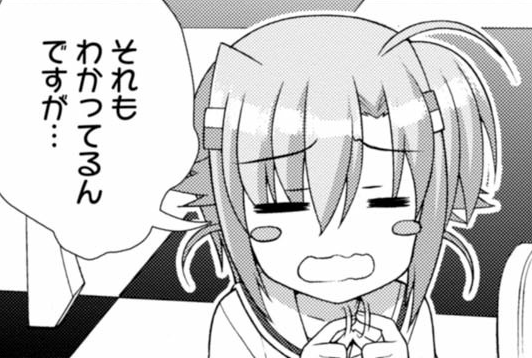
I've got everything else in that balloon but I can't figure out the first character (i.e. the upper right). It says
?れもã‚ã‹ã£ã¦ã‚‹ã‚“ã§ã™ãŒ
...I think... But I can't make any sense of it without knowing what that first word is. I keep running into this character in the Japanese version of the Vivid manga, and it's always a roadblock.
2
Correct. It's a classic hand-written version of "so".
Posted by: sqa at July 07, 2015 10:25 PM (5who7)
3
It's a bit more noticeable when you see the "ten-ten" mark when it shows up for "zo".
In other news, I feel great sympathy for left-handed Japanese. Stroke Order is extremely important in handwritten Japanese not because it's the "Japanese being Japanese", but due to being nearly unreadable if you don't follow the proper order. Context and "slant" are how a lot of it ends up being read, realistically. So it's really rough when you write with the opposite hand.
Posted by: sqa at July 07, 2015 10:30 PM (5who7)
4
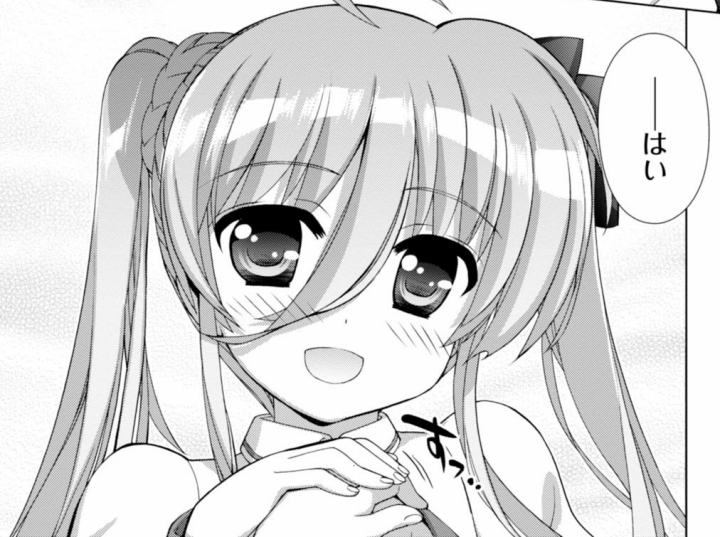
I'm late to the 'ã' party but I'm going to mention that I was sure the question was about the character... er. the girl in the picture.
Posted by: Pete Zaitcev at July 08, 2015 08:26 AM (RqRa5)
5
Her name is Miura.
She's the one who defeats Vivio in the tournament.
6
In case anyone's interested, this is from chapter 66 of the Nanoha Vivid manga, which hasn't been translated into English yet. (The translation project kind of stopped. The last chapter was 54.)
There have been torrents. I just downloaded this one, for instance, which had the first ten collections.
The chapters that have been translated I've gotten from other web sites, in particular this one and this one.
The last raw chapter I have is 72. The last translated one is 54.
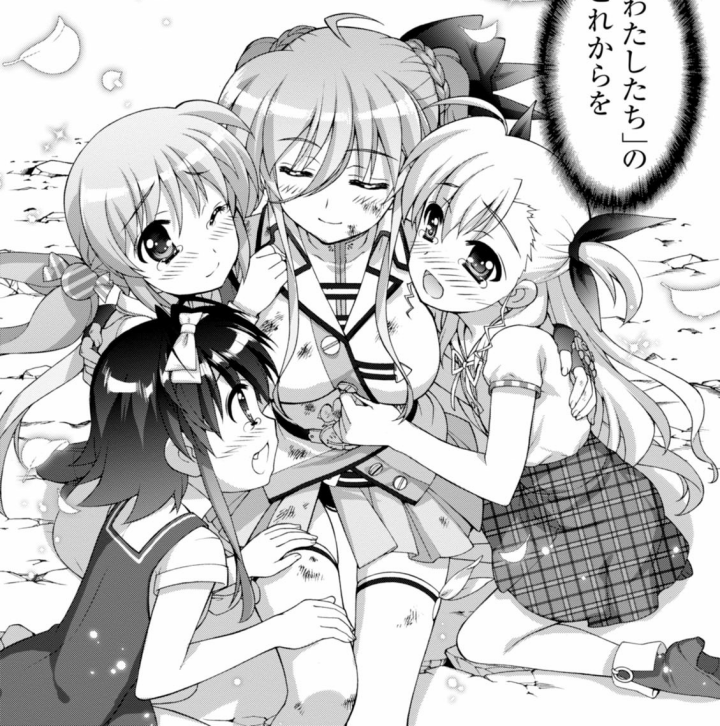
Which is frustrating. There's something really important that happens in chapters 58-61 (in Volume 12), which results in
Vivio beating the crap out of Einhart, and Einhart smiling for the first time afterwards and I can't figure out what brought it about. From other things I've read elsewhere,
Vivio has found her "Sankt Kaiser" mode, which is what she used in StrikerS when she fought Nanoha in the guts of the Cradle. It's profoundly more powerful than her normal "Adult" mode and that's what she uses to beat Einhart. Visually, the difference is that her jacket in "Adult" mode is white and in "Sankt Kaiser" mode it's dark.
I am probably the world's worst Japanese-to-English translator, but I've been trying to pick out particular word balloons which I hope might shed light on the situation and then translating them in my own slow, pitiful way.
But I haven't gotten any hints.
Another mystery is that after Vivio won, Nove chewed her out royally for some reason.


 [/spoiler