Sitting here playing MOO, I had an unoriginal thought. (A common occurrence, I'll have you know.) There's a stale truism that ran something like this: "If the cost and performance of automobiles had changed the way the cost and performance of computers has, a Mercedes Benz would cost $14.95 and go a million miles per gallon."
MOO dates to 1993. 17 years ago. I ran it on my first PC, a 486-SX running a whopping 25 MHz, running MSDOS. I think that it had a 1024*768 display, but I'm not sure it was that large. I'm pretty sure it was a 40 MB hard disk. There was no optical disk; they hadn't come out for computers yet at anything like a reasonable price.
And now what do I have? Alcyone is a quad-core 2-GHz Q9000. The display on this computer is 1920*1080, 24-bit color. It has 6G of RAM and a terabyte of HD. The optical drive reads BD and writes DVD.
If I wasn't so used to it, I'd be terrified. How in hell did things change so fast? Even though I was in the industry, and helped make it happen, it still stuns me. Has there ever been a technology which has spread as fast, and improved as fast, as the integrated circuit?
First, a quick story. Once, when I was about 6 years old, my father asked my great-grandmother (who was then in her 90s) which technological advance she had lived through that most changed her life. He expected her to think a bit about radio, television, cars, computers, etc. But she immediately replied, "Canned food".
I'm not really sure to apply your "improved as fast" metric to canned food. But I expect commercial canning changed people's lives more dramatically and quickly, and spread even faster.
Posted by: DavidVS at May 16, 2010 08:28 PM (+nsU1)
That's a very good point. And I bet that adoption of electricity went like a bat out of hell, too, even in the early days when all they used it for was lighting.
The latter half of the 19th century really was a technological revolution. It's easy to forget just how many things changed back then.
Canned food is something I admit I take for granted, even though deep down I know it's only been around for about 150 years.
As to "improved fast", the fundamental technology has changed but not all that fast.
However, there was a period in there in which the variety of kinds of food being preserved that way must have exploded, with each month bringing something new to the store shelves in bottles or cans. From the point of view of consumers, that is surely an explosive kind of improvement.
I remember a conversation with my parents on the way to church maybe 8 years ago. They were born in 1944 and 1945, and our area was relatively poor. My father, for example, remembers the day he came home from school when he was eight, and they had finished installing an electric light in the house.
They were talking about how my mom had put a load of clothes in the washing machine, and had started a loaf going in the bread maker. They told me and my sister that when they were growing up, one day a week was set aside for both those chores: Monday was for baking bread for the week, and Tuesday was for washing clothes, which they still did with a washboard. Their mothers couldn't work outside the home, because how would those tasks get done? My dad also talked about how wonderful it was to have indoor plumbing. My grandmother on my mother's side still lived in the house where my mom grew up until I was about eight or so. She still had an outhouse, until she moved into a senior citizen's apartment.
When I did my hitch in Afghanistan, I was on a team charged with clearing mines for base expansion. The civilian contractors we worked with told us that they had to use painted rocks instead of wooden stakes, because the locals would steal the wood for fuel. Note that the expansion worked outward from the existing base, so to do this they'd have to go through the uncleared area. Can you imagine being so poor you'd walk through a minefield for some 1x1's 12 inches long?
Living in America in the 21st century is f*cking amazing.
Posted by: CatCube at May 16, 2010 09:32 PM (Te0W1)
5
The faster technology progresses, the faster it allows for new technology to be made.Therefore, recent innovations such as the integrated circuit are more likely to improve faster than previous technologies.
9
Not sure it's measurable, but modern medicine, taken as a whole, is up
there. My grandmother had some very long rehab times after
various cardiac surgeries in the 1980s, now stuff like balloon
angioplasty is practically outpatient. And "we figured out germ
theory" to "we figured out gene therapy" in about 150 years isn't bad.
Obviously not Moore's-Law level for most quantifiable purposes (we're
not doubling life expectancy every 2 years, or even doubling the number of
conditions we can cure), but it's harder to measure the "quality of
life" you get from good medicine.
And of course, medicine has piggybacked on semiconductors for a lot of
the most-recent boosts (MRI machines, gene sequencing), so as an
engineer, I'll claim partial credit.
Many of the technologies mentioned above did have some serious boosts
along the way, but none really kept up a Moore's-Law level of
improvement over a 40-year stretch, like semiconductors have.
Posted by: Mikeski at May 17, 2010 11:57 AM (CT8LT)
10
Admittedly semiconductors are one of the major reasons, but between processors, memory, and communications technology, I wouldn't be surprised if the growth in telecommunications technology, that is, the ability to move data from point A to point B, would be increasing faster than Moore's law for some metrics. (I'm in the middle of an IT management class, so I'm reduced to speaking business-speak; have mercy on me.) I'm sure if you measured my ability to get information from point A to point B you could come up with some viable way to measure it.
It's not until I think about it that it scares me; not only am I moving an amount of data that would be incomprehensible a decade ago, I'm sending it to a co-workers cellphone in south-west asia. I have access to a good portion of the combined knowledge of humanity, at my fingertips, just about anywhere people live on Earth.
Posted by: Civilis at May 17, 2010 03:12 PM (ppZrq)
11
It's not going to win any prizes for rapid change, but another under-appreciated technology is stainless steel. Modern pharmaceuticals just aren't possible in bulk without it.
15
In fact, a gigabit connection can carry that much data on a lot of streams at once, but I'm not sure it could to it on a single one. The handshake latency between LA and NYC combined with the TCP window size (Is that the right technical term? I haven't worked on that stuff since the mid 1980's when I was at BBN) would mean that the effective transfer speed would be drastically gated.
16
Here's one... it's enabled, of course, by the microprocessor, but measured by its own merits, it shows a rather impressive growth.
Sales and accounting.
Think about it... while ledgers of some form were used on occasion by beancounters throughout history, most enterprises never seriously wrote down what they had on hand or whether they were really making any money. Those who did, had little in the way of standardized procedures, and most sales were made through haggling.
The mechanical cash register helped speed up sales. But, inventory was whatever was on the shelves, and revenue was whatever was left in the till. GAAP and other standardized rules cleaned up the ledgers somewhat, but the process was still entirely manual.
Then, hand in hand with the microprocessor, the laser, and digital communications, the whole business world changed within a single lifetime. We've gone from mechanical cash registers to laser scanners with built-in radios that update databases and spreadsheets throughout the length of the company's supply chain, up to and including filing electronic tax forms and generating stockholder reports. Heck, a small business now can skip the whole selling thing and rent Amazon's shopping cart, complete with all the paperwork and reporting most small businesses need.
Posted by: BigD at May 17, 2010 07:11 PM (LjWr8)
17
Yes, but how has the "bandwith" of sneakernet improved with the improvements in technology? Right now, in my hands, I have the storage capacity of approximately 2.6 million floppy disks. In my phone. The actual card is the size of my fingernail. (*pause while mind boggles*) Admittedly, this is more directly related to the decreasing size / cost of semiconductors. But if I wanted to get 500GB of data from here to middle-of-nowhere in some third-world country, even via sneakernet, the cost/time has decreased significantly.
And this also relates to BigD's statement about sales and accounting, which are subsets of information. If I'm sending it to most places in the first world, I can track that 500GB sneakernet almost every step of the way, door-to-door, in real time. Logistics, inventory, record-keeping, all those ones and zeroes... the ability to move, organize, search and display those records, regardless of industry, has grown fantastically.
Posted by: Civilis at May 18, 2010 01:53 AM (X3aZm)
18
As far as data transfer goes, we do an awful lot of Fedex shipping of hard drives.
Lots of our clients don't have a real commercial-grade internet connection. They can download enough to handle their partners' and associates' web browsing, but feeding them more than a gig or two at a time is a bad idea. They'll take days to get it, and the chance that their connection will pack it in at some point during the transfer goes up a lot.
At the same time, it's worth it for them to get the data now, now, now. If you're billing hundreds of dollars an hour for every worker, you want them busy, not idle waiting for data to transfer. So dropping sixty bucks on Fedex shipping is nothing, if it gives you a whole extra day of review.
Some clients have a really nice computer system, though (usually big firms that move a lot of data in and out). Ten gigs overnight, no problem at all. But even they get hard drives for 50 or 100 GB productions.
The limiting factor THERE is the drive transfer speed. USB2.0 is pretty darned slow. E-SATA is nice, but the guy on the other end almost certainly doesn't have a machine set up to accommodate it. (Our clients are, by and large, not technically competent...) We've had plenty of drives miss a shipping window because the file copy took too long, and that's with a multi-threaded copying tool; if you tried to use Windows copy, you might as well use carrier pigeons.
Back to the topic, and perhaps a little derivative with respect to the integrated circuit, but cell phones. This isn't just a difference in one device; in half a generation we've gone from a society in which voice communication could only take place at certain points, to one where it's unusual if you're disconnected from the network for any amount of time at all. To think of it another way, the ease of contacting you was once a function of your physical location and your job; now it's largely a matter of personal choice, with the individual able to go from "post office mail only" to "available 24-7" and back at a whim.
Posted by: Avatar_exADV at May 18, 2010 02:13 AM (pWQz4)
My opinion is that progress in the field of computer technology is proceeding much faster mostly because the vast majority of the "progress" is mathematical, rather than physical. Writing a new piece of software takes time, but non-digital inventions take time, physical labor, and the movement of physical matter in large quantities to implement in any way; you can't just issue a software patch to fix a damaged road. There simply isn't any comparison between the speed of mathematical modeling (which, to be honest, is what computers do almost exclusively, in an amazing variety of ways) and the speed of industrial production and distribution.
Unfortunately, the rush for such easy innovation has led to an unfortunate tendency among many intellectuals to believe that reality can be changed with computer models, similar to the tendency of accountants to believe numbers are more important that the physical inventory they evaluate. The Church of Climate Change is the most egregious reflection of this, a group that actually believes in a clearly flawed computer model so much that they feel entire governments must be forced to cripple themselves to satisfy its wild prophecies. Worse, the USA has allowed much of its physical production capability to atrophy, in favor of the "high-tech" industry that can deliver efficiency upgrades in leaps and bounds, but needs to have some physical production capability to upgrade in order to have any effect.
The pen is mightier than the sword, but it's not a replacement for it.
Posted by: Tatterdemalian at May 18, 2010 05:18 AM (4njWT)
20
Long-distance TCP performance has improved a lot since the Eighties, but I'd be quite surprised if an out-of-the-box desktop computer could fill an LA-NY gigabit pipe with a single stream.
In the late Nineties, we had to move 18 GB from California to New Orleans in a hurry (last-minute demo updates for a chip-design trade show), and we had a rented T3 line. In theory, we could copy the data in about an hour; in practice, it was going to take more than a day until we broke it up into multiple streams. And we had high-end Unix servers on both ends, with the data on expensive file servers.
Now I carry 16GB in my pocket digicam...
-j
Posted by: J Greely at May 18, 2010 10:27 AM (fpXGN)
21
Not too long ago I had to transfer about 120gb of data to an offshore agency overnight. Ideally we would have shipped it, but we didn't have the mechanisms in place at the levels necessary, as this was basically a case of developers on the other end realizing they needed data from developers at our end ASAP.
The solution we came up with was to set up a torrent and then sneakernet the data to three other local locations that had fat pipes for additional seeds. At the other end they started leeching the torrent from four locations and played with the file order priorities. None of their sites finished the transfer overnight, but because of the ordering they were able to carry a drive to their four locations and build the complete package in time.
Posted by: David at May 18, 2010 11:04 AM (oyblT)
22
Yeah, BitTorrent can be scary efficient. I used to use it to distribute half-gig content updates to 750 servers every week. Even with a single seed, the swarm made very effective use of the bandwidth.
Amusingly, all of these servers were running Solaris, in a Microsoft production data center.
-j
Posted by: J Greely at May 18, 2010 12:14 PM (fpXGN)
23James has an example, and it's a good one: the airplane. The Wright's flew for the first time in 1903. 15 years later, 1918, thousands of aircraft were being used in WWI, and thousands more were in use all over the world. And the performance increases were quite dramatic.
24
The above comments made me think of another candidate, which is the root of many of them: the industrial era forge/kiln/oven.
For most of the history of iron working, smiths had no method to keep their forges at a constant temperature or control how much carbon was in the air. The result was unpredictable quality steel: sometimes too brittle (breaks easily) and sometimes too soft (won't hold an edge).
Very rarely the alloy would have the optimal amount of carbon, so the steel would be very sturdy and hold an edge. Thus all iron-using cultures had stories of rare "magic" weapons that could cut through normal ones and seemed to always stay sharp.
A few cultures discovered that the smith could purposefully err in either direction and then laboriously combine brittle and soft layers. This allowed "great" steel on demand but was incredibly expensive to do.
The invention of modern forges/kilns/ovens allows inexpensively creating "great" steel every time.
I'm not sure how fast that technology spread, but it is the root of the integrated circuit, commercial canned food, the electric motor, stainless steel, etc. -- and things like modern medicine that depend on these.
Posted by: DavidVS at May 21, 2010 11:27 PM (+nsU1)
We're hearing from all over that a bad McAfee for Windows XP update is causing computers worldwide to shut down. Apparently DAT update 5958 deletes the svchost.exe file, which then triggers a false-positive in McAfee itself and sets off a chain of uncontrolled restarts and loss of networking functionality.
And, of course, it was auto-downloaded by most of those machines, because McAfee's antivirus package nags you incessantly if you disable auto-download.
Word is that the only fix McAfee can come up with requires service staff to manually fix each and every computer which was involved. I'm sure that corporate IT departments are overjoyed.
1
Bah, at least IT staff know what to do. If that happened to my daughter who is using her laptop in Japan, it would be the end of the road for that box. The only thing I would trust her to do is to buy a new one.
Posted by: Pete Zaitcev at April 21, 2010 12:26 PM (/ppBw)
2
It appears that the bad update only went to corporate customers, which is good for normal folks, and really, really bad for McAfee. Between losing most of their corporate customers and having to pay for the cleanup, I suspect that big office building on 101 is going to have a "for lease" sign up soon.
-j
Posted by: J Greely at April 21, 2010 12:43 PM (fpXGN)
3
Yep, I got an email about it myself a couple of hours ago.
There is, of course, no way for us users to shut down McAfee virus scanning on our PCs.
When Deacon told me "McAfee is going away soon," he neglected to mention it would be in a blaze of stupidity.
5
Hmm, that's odd. I have McAfee installed on this computer, with auto-updates enabled, and I haven't seen any probl
Posted by: Siergen at April 21, 2010 01:21 PM (0Rm2P)
6
When I got this computer, it came with a 90-day McAfee license. When that license expired, I went to uninstall it, and discovered that I had to go to McAfee's web site to download the uninstall program.
...when I learned that, nothing in this universe could have convinced me to keep using McAfee or to use it ever again.
I've been using Avast! ever since. Perfectly happy with it.
Posted by: atomic_fungus at April 21, 2010 03:54 PM (Pm3HF)
Fry's shipped my copies of Civilization 3 and Civilization IV yesterday. Fedex will deliver them tomorrow.
It's been a long time since I tried to play a game requiring that much mental concentration. I wonder if I can do it any more? (It's hard these days. That's one of the reasons I stopped doing serious blogging.)
I've never played either of these versions of the series. The last one I played was Civ II. So I know that as of Civ 3 they added a lot of new unit types. I assume there are more Wonders of the World. I'm sure the graphics will be much better. I bet the government types are more intricate now, too. I remember that for a lot of that stuff, the only real way to learn how to use them was to louse it up a few times. (Sid Meier doesn't design games for dabblers.)
UPDATE: That was pretty fast work by Fry's. I put in my order about 2:30 PM, and they shipped it same day.
I didn't think Civ3's graphics were all that much improved, to be honest. The rendering of leaders was really fugly, for example. Someone really needs to iron Gandhi's neck.
Lots of new units, wonders, etc. Civ 4 looks like it's tweaked the tech tree a LOT, including a lot of alternate prereqs ("you need a plus one of b or c to get d") for techs, new buildings, a fairly different system of religion, too. (I just started playing a couple days ago.)
I'd recommend doing a small amount of strat-reading for Civ4 because the little bit of research I did suggests there's been a lot of tweaks to make some old strats weak, for example, spamming cities isn't a good plan any more in 4.)
Posted by: RickC at March 24, 2010 10:56 AM (d5FDH)
2
I'm not planning on playing Civ IV immediately. I bought it just in case Civ 3 wouldn't work acceptably on this computer. But if Civ 3 works, Civ IV may spend a year in the cupboard before being opened.
Gotcha. Well, depending on any quirks of your definition of "acceptable," it should be OK; my brand-new HP core i5 handles it, modulo a few weird things like the installer griping that I don't have directx 8 installed (that's meant to be a representative, not an actual, example, and is also what "Run As Administrator" and "run in compatibility mode" are for )
FWIW I have been playing Civ 3 about two weeks, and I'm starting to get bored--too much tedious MM. Civ 4 looks like it might be a big improvement in that regard, but I'm not sure yet.
Posted by: RickC at March 24, 2010 11:08 AM (d5FDH)
4
I have to say- Civ 3 left a bad taste in my mouth. Too much complexity and not much replayability. Civ 4, by comparison, adds ALOT of clever new features that I really liked.
Posted by: Gothmog at March 24, 2010 01:35 PM (ANvHH)
I really hate games that does NOT allow me to 'spam' cities if I choose to, especially through brute force techniques. Pox on the developers' houses!
I like Civ3, though not as much as Civ2. The removal of the terraforming ability Civ2's engineers had, really irritated me. And the fiercer implementation of global warming - yeah, that really impressed me - NOT!
(And yes, I was one of those folks who actual bought the Play the World expansion when it came out. Good thing I never installed it.)
C.T.
Posted by: cxt217 at March 24, 2010 01:40 PM (O7B75)
6
If you are still jonesing for Civ2, there's a rather good clone: FreeCiv.
Posted by: Mark A. Flacy at March 24, 2010 01:57 PM (Lbkvv)
7
I did not like III at all. Biggest problems: 1. Artillery units could be captured if not defended. 2. City flipping from culture: you'd go conquer a city, garrison it with enough to keep it from being retaken, and two turns later, the entire city WITH your army would flip over to the enemy's control. 3. Saltpeter, and the unequal distribution thereof. If you don't have any, surrender, because you can't build gunpowder units..
All that was fixed in IV, but it was much more graphically intensive.
ubu, if you're getting cities flipped you're doing something wrong. I'm not sure what but I leave a big stack on captured cities until I get notified the resistance is ended.
Steven: yes, there are a half-dozen "strategic" resources like iron, rubber, and so on, and if you don't have access to them you can't build units that depend on them. I'll admit to not having played a lot yet but i never was unable to find enough strategic resources to get by.
From the (even less) I've played Civ 4, strategic resources are more widespread yet; I haven't had any trouble finding them. Steven, you need ONE of any given strategic resource to power your entire civilization (that's connected by road to the resource. Getting your empire cut in half, when all your big production cities are on the opposite side of your empire from the one with saltpeter really sucks, heh, but it teaches you a lesson about the SHAPE of your empire. )
Posted by: RickC at March 24, 2010 05:01 PM (aXVvl)
10
Oh, forgot to say, I found artillery units lame enough that I just stopped making 'em, so no worries about losing 'em.
Posted by: RickC at March 24, 2010 05:03 PM (aXVvl)
11
Make sure to patch Civ 3. One of the largest initial complaints was how severe the corruption penalty could become if you tried to make a large civilization. Since that corruption effects both trade and production it was quite easy to grind your entire civilization to a halt by overexpansion. Before that patch came out I ended up razing every city I conquered to control corruption and provide unpaid 'slave' workers to improve my own territory.
Additionally units gain experience in Civ 3. They go from Regular (3hp) to Veteran (4hp) to Elite (5hp). When it shipped the game was bugged so that Elite units were calculated as having no strength. That led to a single unit holding of hordes of barbarians as a Veteran, and then dying the moment it was promoted to Elite.
Civ 4 took all of the concepts in Civ 3 and substantially improved on them.
Posted by: Betelgeuse at March 24, 2010 06:06 PM (qMdAP)
12
Back in Civ3, they added "strategic resources". You can't see them on the map until you get the appropriate enabling technology. When you get one (generally by linking to it by a road and building an improvement on it), everything linked to the transportation network gets access to the units that require that. Thus, it's a lot easier to manage an empire with a few ports and some rivers than it is to deal with a totally land-locked, dry area.
Civ4 has a slightly larger selection of strategic resources, but they're not quite as important - there's more alternatives where having the resource is an advantage but not an overwhelming one. You can, of course, trade for them - each instance of the resource on the map will provide enough for one civilization, so if you've got three horses, you can trade horses to two other civs.
There are also luxury goods, and usually you'll get them in clumps. Each luxury is one happy person everywhere you have it available, so if you have a wide variety of luxuries, you have a much, much easier time keeping your cities happy and productive.
In Civ4, you also get a similar effect from religions - so you want as many religions as possible in your cities, and you want your neighbors to have the religions which you "founded" by being the first one to pick up the related technology. Not only does this ease diplomatic relations, but you also can get ancillary benefits (extra income, etc.) I've won more than one game by aggressively proselytizing with missionaries...
Civ3 wasn't BAD. It was a lot of fun when it came out. But Civ4 is substantially similar everywhere Civ3 was good, and with many refinements that make it even more enjoyable.
Posted by: Avatar_exADV at March 24, 2010 06:32 PM (pWQz4)
13
Don't forget about the various mods available for both 3 and 4. I can't remember the last time I played a vanilla game of either. In particular, Sevomod for Civ 4 is outstanding. More civs (I'm currently about to conquer the world as the Dutch, and my main rivals are the Malinese and the Australians), more unique units, more units in general, more "great people", more varieties in gameplay... it's just excellent.
Posted by: Wonderduck at March 24, 2010 07:01 PM (mfPs/)
14
The thing me and my wife always hated about Civ3 was how the computer cheated horribly in battle. Their spear men would beat your tanks, and all that. Well, not *always* against tanks. . . but this is why her strategy was basically "avoid war, climb tech tree ASAP, giant tank assault against foes still at medieval tech."
Posted by: metaphysician at March 24, 2010 07:04 PM (DQ9zJ)
After years of play I'm finally getting sick of Spider Solitaire, and a few nights ago I decided to take the plunge and try buying a game from Good Old Games.
I rather hoped they'd have one of the "Civilization" games; that was what I really felt like playing. But the only turn-based strategy game in their list was "Heroes of Might and Magic". I remember playing that one and found it dull.
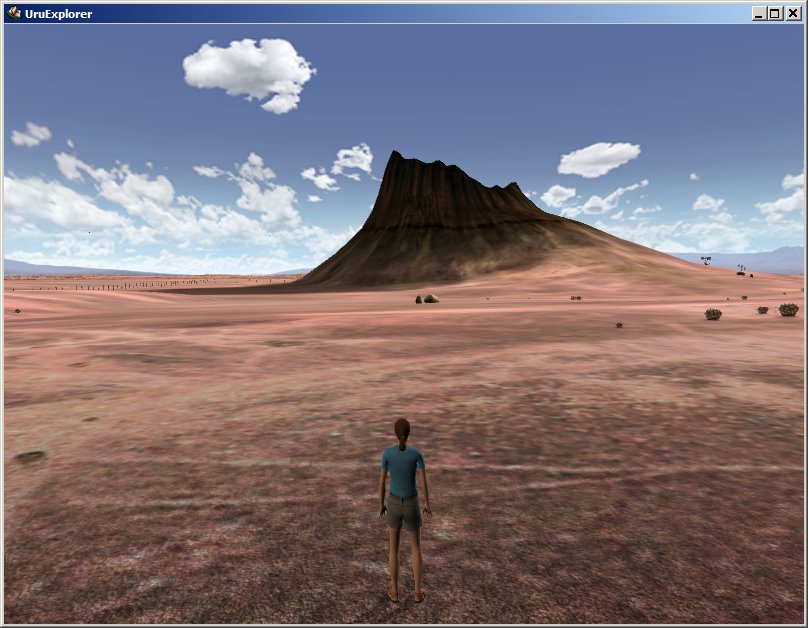
So I ended up getting something called "Uru Complete Chronicles". As described it's an incomplete game and the main attraction is to wander around and look at all the graphically amazing vistas. Sounded about right to me, so $10 goes ka-ching, and I downloaded it.
And began running it, and you know what I saw?
Godforsaken Desert, that's what I saw.
The whole area is surrounded by a barbed wire fence that I can't climb. I'm trapped inside it. The cinder cone is also surrounded by a barbed wire fence, which I can't climb or jump over. In the area between there's a lot of sand, a lot of sage brush, a guy sitting beside an Airstream trailer, the skeleton of some giant creature, and a hole in the ground that I can climb down into. It ain't a very big hole. There ain't a whole lot down in the hole. There sure as hell ain't any enchanting vistas.
In various places (e.g. inside the skull of that skeleton) there are pieces of cloth hanging which have what look like handprints on them. If you touch those, they glow and make a sound, all except one of them which didn't do a thing. I spent a couple of hours wandering around trying to figure out how to get transported somewhere else that would be more interesting, and then rediscovered something: these kinds of first-person games give me motion sickness.
Oh, yeah, one other thing. I never figured out how to save my game. When I fired it up again today, I started over.
1
They do have Call to Power 2, which is a Civ game (the first one was called Civilization: Call to Power, but then Activision lost the naming rights somehow).
Uru is one of the sequels to Myst; they all appear to involve the kind of pointless puzzles that I hate, so I've never played any of them.
Posted by: Pixy Misa at March 23, 2010 04:28 PM (PiXy!)
Uru was going to have a bunch of online content and stuff, and then that got cancelled.
As for the Civilization games, if you can get to wal-mart, target, etc., you can usually find Civ 3 for $10 and Civ 4 for $20...altho Civ 4, which I just picked up last night, is a bit quirky as far as the installer goes under Windows 7.
Posted by: RickC at March 23, 2010 05:39 PM (aXVvl)
4
Rick, the installer for Civ4 was quirky under XP! The announcement for Civ5 got me wanting to play again, so I tried to install 4 on my system. I wound up having to copy the contents of both CDs to my main hard drive and install from that, while having the physical disc in my DVD drive... which is the workaround recommended by Firaxis.
Posted by: Wonderduck at March 23, 2010 06:08 PM (mfPs/)
The big thing I'm worried about now when it comes to games is if they "know" that the screen is 4:3. Some of the games I've got around here are unplayable because of that. "Pandora's Box" is an example; it goes into full-screen 1024*768 mode. My display will support 1024*768, but my display is 16:9, not 4:3, so the aspect ratio is off. Given that a lot of "Pandora's Box" is about reconstructing scrambled pictures, it's a lot tougher since the pictures don't look right even after they've been reconstructed.
One thing that was nice about the GOG version of uru was that it could be played full screen, but you could also window it. It "knows" that the screen is 4:3, but that just means the window is 4:3. (I was using 1280*960.)
On the other hand, it's strange. The window is locked into the upper left corner of the screen -- which is a problem, because I have the task bar on the left side. To play it I had to move the task bar. It also does strange things to the mouse pointer.
Anyway, Civ 3 is the one I really want to play, but that's old enough so it may force full-screen and "know" that it is 4:3. If so, I'll be peeved.
6
I don't expect to play another PC-based game until the convergence is complete. PSP all the way. Also, check out the NDS3D, the news exploded on the Internet today.
Posted by: Pete Zaitcev at March 23, 2010 06:52 PM (/ppBw)
7
Civ4 starts in 4:3, but you can adjust it to whatever your monitor's resolution is.
Civ3 only runs in 1024x768. However, from CivFanatics.com's Civ3 FAQ page:
By default, the game runs in a 1024x768 resolution. To get it to run in
a higher resolution, navigate to your Civilization 3 folder (default: C:/Program
Files/Infogrames Interactive/Civilization 3/ -- if you have PTW or C3C,
go to that folder inside your Civ3 one), and open your .ini file
(named Civilization3.ini for Vanilla,
ptw.ini for Play the World, and
conquests.ini for Conquests).
Add a line at the bottom that says: KeepRes=1 . Now, when you
load your game, it'll use your computer's default resolution.
Posted by: Wonderduck at March 23, 2010 06:56 PM (mfPs/)
8
Hooboy. I wonder how it would look at 1920*1080?
If it stretches it, then that KeepRes feature is useless. I might as well let the display chip run 1024*768.
What I really wish is that when the display chip is in a mode which has a different aspect ratio than the physical display, that it would letterbox to make the aspect ratio correct.
Uru was originally designed to be Myst Online, so it's a terrible introduction to the Myst universe. The fiction is impenetratable to people who haven't followed the universe closely, or don't visit its fansites to seek help from the fan community.
You are better off playing the other games in the Myst series, they work much better as self-contained games.
Oh by the way, Uru, as Myst Online, has been released for free (in the sense of "soon to become open source", not in the sense of "free-to-play, pay-to-have-goodies"), so you don't even need to pay anything for it.
>how to save my game The progress is automatically saved. All the cloths you've touched are recorded. You just need to find all of them; some are hidden behind puzzles.
Steven, if your laptop doesn't have the ability to maintain aspect ratio, I'd be shocked. Mine does: Civ3 plays 1024x768, and i get vertical bars with the extra resolution. Civ4 handles widescreen. Also target and best buy and places like that usually have a decent stock of older games for $10-20.
wonderduck, that's horrifying. At least the installers for both games ran OK on my Win7-64bit laptop.
Pete, what's NDS3D? A new version of the Nintendo DS? that's obnoxious, with the DSi XL dropping this week.
Posted by: RickC at March 24, 2010 08:48 AM (If1ri)
14
I found a control one time that said it would maintain aspect ratio, but when I tried it it didn't work.
15
Hm. Sometimes there's a BIOS setting, and sometimes there's one on the video card control panel, and of course that's going to vary across hardware. All I can tell you is I did something and Civ3 plays without stretching, so it is technically possible.
Posted by: RickC at March 24, 2010 11:10 AM (d5FDH)
16
GOG have just announced they'll be releasing both Master of Orion and Master of Magic in April.
Posted by: Pixy Misa at March 25, 2010 06:18 AM (PiXy!)
If a client computer has been assigned an IP by DHCP and has several days left to run on its lease, and that computer reboots, when it comes back up does it do a new DHCP request, or keep using the previous lease? (This would be WinXP and Win7, two computers.)
UPDATE: OK, this shouldn't affect any of you in any way. I just redeployed my LAN so that everything is in the 169.254.*.* block instead of 192.168.1.*. That included changing the IP of one of the ethernet interfaces on the Qube, the one connecting to my LAN.
Also, now both Arcturus and Alcyone are using DHCP instead of having their IP's manually set.
UPDATE: There was a small problem that required rebooting the server.
1
Windows always renews when it brings up the interface, at least in my practice it does. Linux does it too. The overhead is not considered prohibitive. And the primary function of the lease is to weed out dead clients, not to save on DHCP traffic.
Posted by: Pete Zaitcev at March 20, 2010 07:28 PM (/ppBw)
It makes sense that it would, since when the computer comes up it doesn't know whether it's connected to the same network it was on before. Thus the previous IP might not work.
3
I've run into situations where a reboot or even a hard power off doesn't reset the IP and you have to force it on the command line. However, that's always been in enterprise shops, so I'd bet on it being something that happens when a machine is joined to a domain, or that it's something you can configure on the DHCP server that tells a client to keep the lease until it expires.
Posted by: David at March 20, 2010 09:11 PM (rlE2m)
4169.254/16 block is used for link-local communication when DHCP is not available. A renumbering of a real network into that block is probably a bad idea. I saw devices that confugured aliases in that range automatically, in order to support exotics such as Multicast DNS and Apple Randevous. That said, at worst you'll hit a conflict and renumber again, so suit yourself.
Posted by: Pete Zaitcev at March 20, 2010 09:25 PM (/ppBw)
That's precisely the reason I wanted to use it. When I want to restore a computer from backup, the boot disk to connect to Deneb allocates itself an IP in that block, which means Deneb has to be in that block or else the computer being restored can't find it.
I ran into that a couple of weeks ago when I wanted to restore Alcyone from backup. It didn't work.
Tomorrow I'm going to try the process again, at least to the point where I know that Alcyone and Deneb are talking, so that in future if I really do need to restore, I'll know it works.
It looks as if it chooses an IP at random. Since I only have four computers, and it's a 16-bit address space, and I can if necessary turn off two of them during the restore process, the chance of an IP collision is really low.
I probably ought to send the iPaq back, but I don't really want to. Even if the only thing it's good for is watching anime in the bedroom, it's still kind of cool.
With no serial access to the iPaq, and with no other device around here which can read and write the CF, then it suddenly sounds like 32G of the 64G storage on that thing is useless. But I figured out how to move files from the SD to the CF.
But man, it is slow! Yesterday I converted the 12 episodes of Macademi Wasshoi and put them on the SD. Now I'm copying them (2.3G) to the CF. It's been two and a half hours and it isn't through yet.
Oh, well; it's not like I need it for anything else. In the mean time I'm doing some more conversions. I just finished converting Negima ala Alba and now I'm converting Aika Zero.
I would convert the first 14 eps of Railgun except that ep 10 from Chihiro has lousy sound, and I don't want to use Ayako. There's a batch just posted which I'm downloading which contains Chihiro's versions up through ep 19, and that includes fixed versions of some of the episodes, so I'm going to wait until that is done and convert the first 14 eps from it. And I think I'm going to do all of Realbout High School.
When you're using about 300 MB per episode, you can fit a hell of a lot into 64G of storage. This much won't even make a dent in it.
And I think I'll rip ep 9 of Kamichu.
UPDATE: Three episodes of Negima ala Alba totalling 953 MB. How long do you think it took to move them from the SD to the CF?
43 minutes. That's 22 megabytes per minute, or 378 kilobytes per second.
1
This might be academic, since your USB connection seems to be dead, but..
Settings ->
Connections tab ->
Connections icon ->
Advanced tab ->
Select Networks button
Select My Work Network from the first list (title starts "Programs that automatically connect to the Internet...") Edit... button -> Proxy Settings tab
Check This network connects to the Internet checkbox, leave the next checkbox unchecked
Hit the ok buttons until back to the Connections tab of Settings
(This next part may not be necessary) Network Cards icon
Select Work from the first list, titled "My network card connects to:"
Select Remote-NDIS Host from the lower list and select Use server-assigned IP address from the radio list
Hit the ok buttons until back to the Connections tab of Settings
Plug your iPAQ in.
One debugging check: on your PC, when you plug your iPAQ in a new network adapter should show up, if you bring up a shell window and do an ipconfig it should have an address of 169.254.2.2. On your iPAQ, if you go back to that Remote-NDIS Host page, you should see an address of 169.254.2.1.
If that doesn't work, try this also: Settings -> System tab -> USB to PC icon
Uncheck Enable advanced network functionality, hit ok
I should try setting up to connect via Bluetooth...
CompactFlash readers are pretty widely available, though performance varies a lot. Alcyone is a laptop, right? If so, it probably has either a PC Card (nee PCMCIA) slot or a ExpressCard slot. A CompactFlash to PC Card or ExpressCard adapter is likely the fastest CF reader you'll find, and they're pretty cheap too. There are USB and Firewire CF readers, some of which are quite good. Rob Galbraith has a CF/SD performance database, you can see several CF readers tested against many cards.
I did some testing of read/write performance to some of my CF and SD cards on my Axim PDA, and performance was pitiful compared to my laptop:
I would definitely take the numbers as illustrative, the benchmark programs were different, etc. Looks like writing to either card is the slow part, and 378 KB/s is actually pretty good!
Posted by: Kayle at March 13, 2010 02:24 AM (vVoUI)
2
Kayle, thank you. I'll give it a try later. Who knows? Maybe it'll make the connection work!
Too, there is one more hope. Alcyone supports bluetooth and so does the iPaq, and maybe I can get them to talk that way.
Bluetooth worries me. Does it open up a door that anyone nearby can waltz through and plunder my computer? I'm going to have to do some reading up on it to convince myself it isn't unsafe.
6
Truly pocket-sized means also useful in the bath or spa.
With my toddler, I do not get much reading time. What I have often happens in the spa. I'd need a waterproof e-book reader, or one small enough to fit a specialty camera pouch (for example, http://www.amazon.com/gp/product/B000FE5PBU).
So I usually use my mp3 player in a zip-lock bag, and listen to audio books.
I hadn't thought about it when I asked earlier, but it makes sense that the iPaq would be good for that too (and a netbook wouldn't).
Posted by: DavidVS at March 13, 2010 03:37 PM (+nsU1)
Nope, no network love for me. And it still doesn't seem as if the sync program believes the unit is there.
It doesn't look as if the installation process is all that complicated. I can install apps on the portable storage (TCPMP is on the CF) and it looks like "installation" simply consists of creating a folder and copying files into it. I wonder if I can do that manually instead of relying on the sync program to do it?
9
DavidVS: Think of the iPAQ 210 as something like a keyboardless touchscreen smartphone without the cell radios. A bit larger and heavier (6.6 oz) than any I can think of, but not by a lot. A CPU more powerful than just about any smartphone, except for the 1 GHz Snapdragons (e.g. Nexus One) and probably what's in the iPhone 3GS (just looked it up, it would be comparable except Apple underclocks the CPU). CompactFlash and SecureDigital slots, instead of teensy microSD. Display is 4" diagonal, 640x480, 16-bit color, transflective LCD. Transflective means it supports both reflective and transmissive modes (most LCDs are transmissive), the reflective mode means it is daylight viewable without a backlight, kind of like the PixelQi screen, except it's in color. My understanding is the PixelQi has a higher contrast ratio in reflective mode.
A netbook is far larger, far heavier, with substantially more CPU power, memory, storage, and usually runs a desktop OS.
Really, the nearest comparisons are to things like smartphones, portable media players, internet tablets, and some GPS devices. PDAs were designed as general purpose, so they typically emphasized processing power, memory, display, and storage in a handheld device, while those other devices are relatively specialized so the computing platform is generally reduced to "good enough" to support their other goals.
If Steven merely wants to watch anime away from his computers, he might want to consider switching it out for a portable media player, or maybe something like the Archos 5 Internet Tablet.
Steven: Bluetooth security isn't very good. I did a quick skim of the literature, and my impression is that in theory, the foundations of Bluetooth security is worse than WiFi, but in practice, it's better due to hardware difficulties and severe protocol weaknesses in WiFi. The main problem for attackers is that off-the-shelf hardware that let you sniff encrypted connections is expensive, and it appears that knowledge to modify consumer Bluetooth hardware to go into the equivalent of "promiscuous" mode is not readily available.
Bluetooth's data encryption has known vulnerabilities which might be practically exploitable, but the worse problem is that the initial pairing uses a variable length password which could be arbitrary bits but in practice is always a PIN, digits represented in UTF8, drastically reducing the keyspace. An attacker listening in when the pairing takes place can brute force short PINs very quickly. If the attacker wasn't there at the initial pairing, she can force a repairing, but this will be obvious: your systems will ask you to input a new PIN.
Ok, saw you've actually tried Bluetooth since I started writing this... I'm not having a problem seeing my SD Card though. Here's the steps I used to get Bluetooth going.
Settings -> Connections -> Bluetooth -> Mode -> Checked both Turn on Bluetooth and Make the device visible to other devices -> ok
Clicked on the Bluetooth icon on my laptop's system tray ->
Select Add a Device ->
Selected by PDA from the list of discovered devices ->
On PDA, hit yes -> typed in PIN -> Next ->
Started up ActiveSync on PDA -> Menu -> Connect via Bluetooth
Hmm... on my laptop, the program is "Windows Mobile Device Center", which I guess is Windows 7 new name for ActiveSync.
Some applications will supply .cab files, you can copy those to your iPAQ and then click on them from the File Explorer to do an install. Otherwise, it's like Windows, if you get the files in the right place, update the registry with whatever settings the application needs, that's basically what's happening behind the scenes.
Ok, noticed you reinstalled Windows Mobile Device Center in previous post, I'm guessing things are all messed up from installing earlier versions of ActiveSync. Don't know how you're going to fix that other than by rolling your laptop OS back to before you installed. At least on my laptop. WMDC didn't need to be explicitly installed, it was already there.
Posted by: Kayle at March 13, 2010 05:48 PM (gZxCi)
I cannot figure out how to get the iPaq to reliably connect to Alcyone. In fact, at this point it won't connect at all. Plugging it in does nothing whatever.
It occurred to me that I somehow got mixed versions of the drivers, so the thing to do was to uninstall everything and start from scratch. Only problem is that the uninstallers... don't. Or not completely. So stupid me, I tried manually removing some stuff. And it didn't get reinstalled afterwards.
It occurred to me that what I really needed to do was to roll back from backups and start clean, using the backup from Wednesday morning just before the iPaq was delivered.
But when I tried to do a restore on Alcyone using the special boot disk, it wouldn't. It couldn't find Deneb. I remember running into this before.
There are three blocks of IPs reserved for LAN use. One of them is 10.*.*.*. One of them is 192.168.*.* which is what I use on my LAN. I can't remember what the third one is, but last time I figured out that it's what the restore CD expects to be used. Since Deneb's IP is 192.168.1.2 the restore CD couldn't find it.
I need to get this fixed. What I need to do is to find that other block (anyone know what it is?) and change my whole LAN over to use it.
But given that I couldn't roll back Alcyone, then it occurred to me that maybe I could get the interface software installed on Arcturus, the XP machine I use for torrents. Nope.
On Arcturus I got caught in Adobe hell. Seems that the installer needs Flash 8+. I tried installing Flash, but in order to do that Adobe insisted on installing its download manager first, and that process locked up. I have no idea why.
I tried installing it using FireFox, and succeeded. Only problem is that doing so didn't also install Flash for IE, and it looks like the installation disk is using the IE common libraries in order to reach Flash. The fact that Firefox had it didn't help; the installation disk wouldn't run.
It's not like I need to sync multiple times per day. In fact, the only reason I need it is that it's the only way to get software installed onto the iPaq.
Fortunately, I did manage to get TCPMP over there before everything went sour, so it can still be used as a remote video playing device. But without the sync software running on something, the device is crippled.
The make tree keeps getting bigger. I don't know if I can deal with this.
UPDATE: I found a place on Microsoft's web site where I could download the installer for ActiveSync 4.5. Turns out that the version which is on the CD won't run on XP anyway. So I downloaded and installed ActiveSync 4.5 onto Arcturus and... it can't see the iPaq.
The iPaq doesn't even show up as undifferentiated external storage, the way my camera does. Irrespective of any fancy drivers, that's supposed to work. It's almost as if the USB port on the iPaq is dead or something.
I also downloaded the latest version of Windows Mobile Device Center and installed it on Alcyone. No effect at all.
I have another idea. Very, very unlikely to make any difference, though. I'm using the cable they provided, which connects to a big wide connector on the iPaq. The iPaq also has a mini-USB connector, and next time I go to the store I'm going to buy a cable which can connect to that, and see if it makes any difference.
Very unlikely, but miracles have happened.
I'm near to sending it back, though. I didn't spend $380 on this just to get a hand-held video player.
UPDATE: Nope, the mini-USB doesn't make any difference.
I'm rapidly coming to the conclusion that the USB interface on the iPaq has died. When it's plugged in to either computer I can't see any indication that there's anything there.
Even if nothing else works, when it's plugged in it should show up in the explorer as an attached storage device, like a thumb drive or like my camera. It doesn't even do that -- on either machine.
1
Talk about user-surly. Granted, this may just be my lack of expertise, but it almost sounds like the damn thing falls apart whenever one attempts to do anything even slightly unplanned.
( or maybe excess user-friendliness: its built to make it easy to do certain intended and advertised things. . . but with zero accomodation or planning for users doing other stuff )
Posted by: metaphysician at March 12, 2010 01:16 PM (DQ9zJ)
2
Actually, the unintended stuff works. It's the usual and expected which is failing.
Just some random stuff, in part so I myself can find them.
The user interface of the iPaq is enough different from Windows to really confuse me. It's not like the Jornada, which was WinCE. WinCE really did follow standard Windows conventions, but this OS, whatever it's called, changes things.
One thing is that the boxed X icon in the upper right corner of the screen doesn't terminate the current app. It's equivalent to "shove into the background", but it leaves the app running. There's a frame you can get into which shows all the currently running apps, and permits you to kill them, and yesterday afternoon I drove myself nuts trying to find it, and couldn't. Just now I did again.
On the default screen, one of the lines shows the amount of free memory in various places, plus has a mini-control for the screen brightness. If you double-click that, one of the tabs is "Running Programs". That's where you go to turn off Windows Media Player. That's also where you go to make sure that ActiveSync is running, because if it isn't, you can't connect to the PC with the USB cable.
I also leave TCPMP running. That way I can use the file explorer to look at the SD card (which is where I'm storing anime for the time being) and double-click a file and have it start playing immediately.
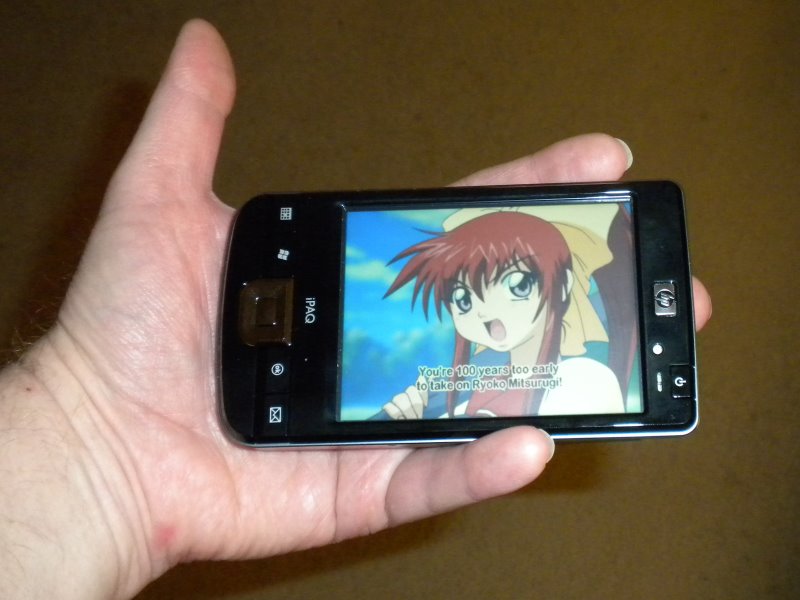
Watching an anime on this device is nicer than I expected it to be. In physical terms it's still a rather small screen, but not intolerably so. Using it with headphones the sound is very good. And when I was sitting on my couch, it was in some ways better than using the big computer.
There are a lot of cooling fans here on the computer desk, between Regulus and Deneb and Alcyone, and that creates a kind of background of white noise, what I'm used to calling a "noise floor". When I was sitting on the couch I was far enough away to not have that, and some of the silent parts of the sound track really were silent, like they ought to be. If I watched it in my bedroom it would be even better yet.
Kayle, I would definitely appreciate hearing how you have networking set up.
Toren writes to tell me that his experience is that AllToAVI is the only reasonable tool for what I'm doing. It certainly works for me, albeit not all that rapidly. I discovered that when you choose the "bits per second" value you aren't limited to just the ones in the pull-down menu. The highest choice there was 1000 kbits per second, and at least for the first pass I'd like it to be bigger than that. So I manually entered 2000, but I might use even higher values in future. (2000 yields a file that's about 370M, and presumably minimizes additional codec artifacts.)
He also mentioned that it doesn't saturate his dual-CPU machine. I took a look at the task manager, and what's happening here is that AllToAVI itself is saturating one of my four CPUs, and something called "mencoder" is saturating a second one. So why not him? He hasn't answered me back yet, but I conjecture that he was manipulating files on an external USB drive, and was probably transfer-rate limited. I've been doing my conversions using one of the internal HDs on this computer, which are fast SATA. (Alcyone has two 500G drives.)
This thing is a Barbie Doll. I'm already beginning to lust after some extras. A desk stand for it, for example, would be really nice. I could permanently wire it to USB and the power brick and not have all the damned cables getting in the way constantly.
I need to come up with a name. "Steven's PDA" (which was what the setup program defaulted to) is really boring. Maybe I should name it "Uiharu". (Except that's not an astronomical name.) I suppose I could use Pollux, but that's a snore.
I am tempted to go with Uiharu. I'm not obligated to remain consistent in my naming.
UPDATE: This is what it looks like when playing video:
Except that the flash makes the screen look more washed out than it really is.
UPDATE: Interesting. There's a "product tour" app on this unit. One of the pages offers some physical specifications. The weight is 188.5 grams with battery. The OS is Windows Mobile 6.0. The Wifi (which I'm not using) is 802.11 b/g. The Bluetooth (which I'm also not using) is V2.0+EDR. The battery is rated 2200 mAh.
UPDATE: The main frustration right now is that I can't get connected reliably. When I plug the cable in, it ought to synchronize immediately. ActiveSync is running on the iPaq and the sync program is running, but they ignore each other, and I can't figure out why.
Yeah, I should have warned you about the "minimize button looks like a close button" thing. Guess Microsoft figured that, since you'd want the smart phone software running in the background all the time to pick up phone calls, all CE software should act the same way (even on devices that have no phone capabilities). There should be a freeware app somewhere that adds a "Close" button to the standard application title bar... for those applications that actually use the standard title bar, instead of going "WEEEEEEEEEEE! I'M MOBILE!" all over your user interface.
As for the ActiveSync thing, I remember it being excessively persnickety about which software versions would talk to each other across the USB cable. I think ActiveSync 4 basically decided it wouldn't talk with ActiveSync 3.8, but would happily chat with all the earlier 3.* versions (and ActiveSync 4+ wouldn't run on my iPaq, for reasons I don't remember), leading to the usual "Damn it Microsoft, I don't WANT to upgrade my driver!" experience.
Posted by: Tatterdemalian at March 11, 2010 10:51 PM (4njWT)
Maybe that's what's going on, but I doubt it. I'm running what came on the CD, or at least I'm pretty sure I am. I did download and install an upgrade from Microsoft, but I also uninstalled it (I think) and restored to what was on the CD.
Maybe I didn't, though. Perhaps I should try again.
3
Well, now I've really fouled it up. It's to late to screw with it any longer, but tomorrow I think I'm going to have to do a restore from backups to get things straightened out. Grumble.
The 32G CF I ordered just got delivered. I'd forgotten how large CFs are. But more to the point, it turns out the iPaq can hold one CF and one SD at the same time, and use them both. So the SD I already had will continue to be of use. That gives me 64G of storage, should I need it.
Since a CF has a parallel interface, is it faster than SD, which is serial? I'm guessing that the answer is "not significantly" because the limiting factor is the speed of the memory chips.
UPDATE: And now to try to fill up some of that space. Wonderduck recommended AllToAVI and VirtualDub as ways of changing files to something I might be able to play.
VirtualDub looks like it understands a bazillion container formats, but MKV is conspicuous by its absence. AllToAVI does understand that one but it seems that it wants to make two passes. But let's see how it goes.
UPDATE: I may be forced to actually read the documentation for AllToAVI (gasp!). I'm using the first episode of RealBout High School as a test, mainly because it was ripped from the R1 DVD and has two audio and three subtitle tracks plus being narrow screen.
The first two times I tried converting it, the conversion process bailed out half way through. Oddly, it didn't give me any error message; it just quit. The resulting fine played fine, except that the audio and video were hugely out of sync.
I decided that the problem was that I'd said it was 29.997 fps. So now I'm redoing it at 24.99etc fps and we'll see how it goes.
The good news? It got the right audio track and the right subtitle track and converted the subtitle to a hardsub, all of which is exactly what I want.
If I can get this one working, next is the first episode of Macademi Wasshoi. That one is wide screen, and I'll want to see if it works converting to 640*360.
UPDATE: AllToAVI is threaded and it is fully utilizing two of my four CPUs. It's still not very fast, but that's OK. It's set up to make batch conversions possible, so I could set it up in the evening and let it run overnight.
UPDATE: The way it looks now is that the reason you have to make two passes is that the first one is about simplification. The output remains H.264, but the way I'm setting it up, the output has hard subs and a single audio file. Then you process that one again through the program, and this time you can change the codecs.
It reminds me of the rabbit's digestive system.
I just recoded that other one, and the new file now shows as MPEG-4 (XviD) for video and MP3 for audio. And now to see if it'll play on the iPaq.
UPDATE: And it works beautifully with TCPMP. I think we have a winner.
One of the physical controls on the iPaq is an 8-way rocker switch. When I have the display in landscape mode and am running a video in TCPMP, then one direction on the rocker switch controls the volume. The other does 5-second skips forward or backward. The center button is play/pause.
Which is really nice, especially when you're in full screen mode.
UPDATE: So how much did the battery get drained by watching one anime episode? Beginning at 100%, when I was done it was 94%. Which means I could watch hours of video without running out of battery power. (Assuming that the readout is linear.)
And since the file I played was 200 MB, I could fit many hours of video on the 32G SD.
1
My longer comment in composition is now partially obsoleted... Various comments:
SDIO is the same as the SD slot.
Reflective mode of display should work better with more light shining on it.
High performance CF cards vastly outperform high performance SD cards (e.g. 4x sequential throughput, 10x small random write). Even ordinary CF cards are faster than high performance SD cards, except for small random writes.
TCPMP is useful, but it hasn't been updated in ages, it's great for playing video formats that were common 2+ years ago, e.g. MPEG-4 video/Mpeg Layer 3 audio, in avi and maybe mkv. (DivX is just MPEG-4 video, not H.264). It shouldn't have any trouble with that AVI you mention.
Another player alternative, CorePlayer Mobile. It's the commercial version of TCPMP. Developers are the same group responsible for Matroska, CoreAVC (and other Core codecs).
There's a version of VirtualDubMod with some MKV support, but its not recommended for use. If you've got the audio and video you want but in different container files, there's mkvmerge and mmg, a GUI front end to it, part of MKVToolnix.
I'll follow up with my networking settings later.
Posted by: Kayle at March 11, 2010 01:20 PM (7JjRk)
2
VirtualDubMod can open matroska files, though it may need a plugin.
Also, I don't see any particular reason why parallel would be faster than serial. For instance, SATA is much faster than PATA.
Posted by: Jordi Vermeulen at March 11, 2010 01:59 PM (5EMw1)
Jordi, PATA was based on an older version of driver electronics.
Given identical driver technologies, serial will always be slower than parallel simply because at the same clock rate more wires can carry more data. It's that straightforward.
4
Of course, like in so many other aspects of engineering, speed is a matter of the weakest link, and when it comes to hard disks these days, the weakest link is usually the transfer speed of the physical drive. Likewise, my SD is high performance and my CF isn't. (The high performance CFs in that size cost four times what mine did, and I don't need the performance.) So like as not in my particular case they're about the same.
I'm trying to get networking up so that I can try to run Windows Update.
Using IE on the iPaq, I can load the default page on my server here, which is also the gateway to the internet. That means I'm into my LAN. Unfortunately, though, no matter what URL I use, I always get that same page.
The key seems to be to set up a proxy, but I'm not just sure what I should be using for that. Probably it should be the IP of the server (192.168.1.1). And I bet the reason I'm getting that one page is because it's trying to use port 80 as the proxy. I'm not really sure what else to set though.
UPDATE: Actually, I can get to everything on my server (Regulus). But Regulus is what I get no matter what base URL I use. I'm not getting past Regulus to get out to the internet, and the port is almost certainly the reason why.
UPDATE: Damn. I don't have a clue as to what I'm supposed to do to get networking to work.
I could enable wifi and leech off my anonymous neighbors -- there are something like 15 within reach -- but that's dishonest. And highly insecure.