
November 30, 2007
When you put the playback into full screen mode, it doesn't louse up the aspect ratio. (That's a configurable parameter; it can be made to do so, but I'm not sure why anyone would want to.)
On this machine, it means I'm playing back normal DVDs onto a 1920*1200 display, of which it's using 1600*1200. There's a bar that appears on the bottom of the screen when you move the mouse that has all the player controls on it, and a few seconds after you stop doing things it vanishes again.
So that means it's a 2.5:1 linear stretch going from a nominal 640*480 to 1600*1200, or 6.25 times the pixels. Some frame grabs below the fold.
Here's a raw frame grab from the fifth episode of Shingu:
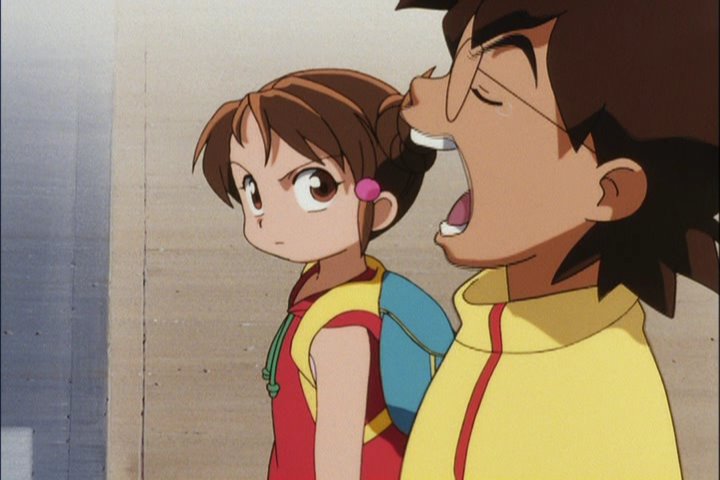
The aspect ratio is wrong because it's 720*480, 3:2, instead of 4:3.
If you take the small display window and resize it to full screen, this is what you get:

Which is about what you'd expect, isn't it? (UPDATE: Actually, not quite. What we're seeing there is one field, not one frame, so the jaggies are even worse.)
What's amazing to me is that if you start playing it, what you get looks like this:

And that is damned good. No sign of big pixels or stairstepping at all. And the CPU load is really low; you can barely see anything going on with the task manager. I have hardware graphical acceleration enabled (the default) and apparently this is all being done there.
In fact, the full size looks so good that it's more comfortable to watch it at that size than smaller. On this display, a 640*480 window is about 4 inches diagonal.
Posted by: Steven Den Beste in Computers at
10:57 PM
| Comments (1)
| Add Comment
Post contains 286 words, total size 2 kb.
You'll frequently run into films (mostly after 1960 or so) that were shot at standard (1.33:1) ratio, but were supposed to be masked at the top and bottom when projected, making a ratio in the range between 1.66:1 (European "wide screen") and 1.85:1 (American "wide screen"). (Woody Allen's "Sleeper" is one-- if you project it in 1.33:1 the proportions are correct, but you'll see lighting units at the top of the screen in a couple of scenes.) Doing a film this way meant (1) the producer didn't have to pay Cinemascope/Panavision for their special lenses and (2) it's possible to create a television print directly by just removing the mask.
There was a big argument a while back when "Yellow Submarine" was released to DVD. It, like "Sleeper," was photographed at 1.33:1, but nearly all theatres showed it using one of the "wide screen" ratios. A lot of people complained because the DVD image wasn't letterboxed to the ratio they remembered, when they were actually seeing MORE of the image than they'd seen before.
FWIW, 70mm (Todd-AO) is 2.20:1 (non anamorphic), Cinemascope/Panavision ranges from 2:35:1-2.55:1 (anamorphic prints) depending on whether the optical soundtrack is present.
The HDTV ratio 1.78:1 doesn't match ANYTHING theatrical.
Posted by: Old Grouch at December 01, 2007 01:40 PM (92326)
Enclose all spoilers in spoiler tags:
[spoiler]your spoiler here[/spoiler]
Spoilers which are not properly tagged will be ruthlessly deleted on sight.
Also, I hate unsolicited suggestions and advice. (Even when you think you're being funny.)
At Chizumatic, we take pride in being incomplete, incorrect, inconsistent, and unfair. We do all of them deliberately.
How to put links in your comment
Comments are disabled. Post is locked.21 queries taking 0.0191 seconds, 18 records returned.
Powered by Minx 1.1.6c-pink.